Google Ad Grants
Google Ad Grants
The Discipline
Paid media has a reputation for being the easy lever: put money in, get traffic out. That has not been my experience of it. Every paid account I have worked in was funded by someone with a sharper claim on the money: a donor who meant it for the mission, a grant with rules attached, a business watching its own runway.
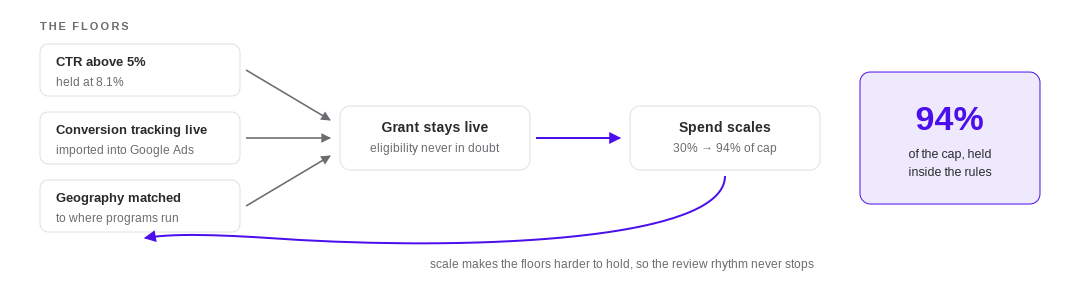
Most of this page is about the Google Ad Grant, the $10,000 a month in search advertising Google gives eligible nonprofits. Plenty of nonprofits have one and barely use it. The money arrives with strings: a click-through floor the account has to hold, conversion tracking it has to prove, keyword rules it has to follow, and none of it spends itself. Both grant accounts I have rebuilt were idling at well under half their value, set up once by someone long gone and never touched again. I have rebuilt two of them to near the cap, at two different organizations, and the pattern of neglect was the same both times.
The method is account hygiene. Search-term reviews that feed a standing negative-keyword list. A clean split between brand and non-brand terms. Bidding pointed at conversions the account can actually see, and landing pages that give the click somewhere worth arriving. Grant or no grant, that is just paid search done properly, which is why the same discipline transferred when the dollars were bought instead of granted.
As elsewhere on this site, client names are withheld from the copy. The numbers are real, and the work is described exactly.
Reviving an Underused Ad Grant
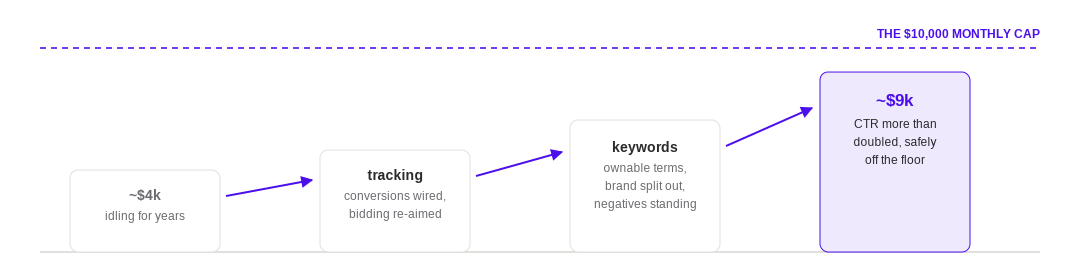
A national nonprofit had held a $10,000 monthly Ad Grant for about five years and was spending roughly $4,100 of it. An outside agency had configured the account around 2019; after that engagement ended, it got only light maintenance. My part was the search side of the rebuild: the keywords, the landing pages, and the tracking. What we inherited was twelve campaigns and some two hundred keywords, mostly broad match, with duplicated themes, outdated ad copy, and almost no active conversion goals. Click-through drifted in the mid-fives, a slow month above the program's 5 percent floor, while policy recommendations piled up inside the account, unread.
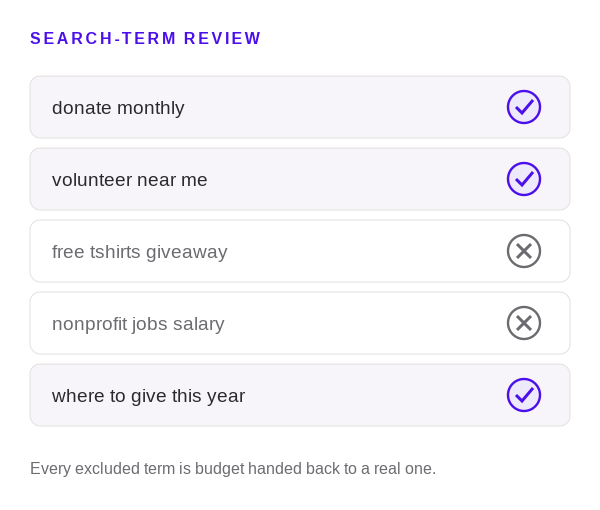
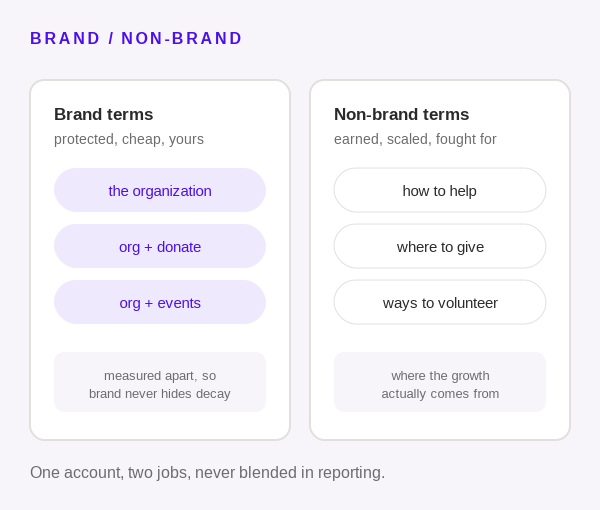
The rebuild started with the plumbing. Conversion tracking went in through Tag Manager so the account could finally see what mattered, with the donation confirmation page as the primary event and newsletter signups, event registrations, and volunteer interest counted behind it. The account started on Maximize Conversions, and the highest-volume campaigns moved to Target CPA once tracking matured. The keyword estate was rebuilt around terms the organization could genuinely own, split cleanly between brand and non-brand, with a standing search-term review feeding the negative list that keeps grant traffic honest.
The clicks also needed somewhere worth landing. Donation, volunteer, and event pages were rebuilt around simpler calls to action, fewer distractions, cleaner mobile layouts, and faster loads. Average Quality Score rose from 5.8 to 7.6, with the highest-volume keywords reaching 8 to 10. Utilization climbed from about $4,100 to about $9,000 a month over six months, click-through more than doubled, and tracked conversions went from about 140 a month to about 255.
Paid social ran as the grant's counterpart at the other end of the funnel: five months of Meta retargeting against first-party audiences the organization already owned, from abandoned donation visitors to past volunteers and event participants. It returned 3.9x against confirmed online donation revenue, and between them the paid channels assisted roughly a third of new email subscribers, with email captures up 47 percent. Where those subscribers went next is its own page.

Monthly utilization from about $4,100 to about $9,000 in six months, against the $10,000 cap
Tracked conversions from about 140 to about 255 a month, with Quality Score up from 5.8 to 7.6
3.9x ROAS on five months of Meta retargeting, measured against confirmed donation revenue
Taking a Second Grant From a Third to the Cap
A second nonprofit, midway through a broader marketing-operations engagement, turned out to be using about 30 percent of the same grant. The account had been created by a regional agency and predated everyone still on staff; nobody internally understood its structure anymore. Nothing it did was visible in analytics, and click-through sat at 4.1 percent, one slow month from the program's floor. This is the normal condition of a nonprofit Ad Grant, and it is why the program has a reputation it does not deserve: the accounts get set up once and abandoned.
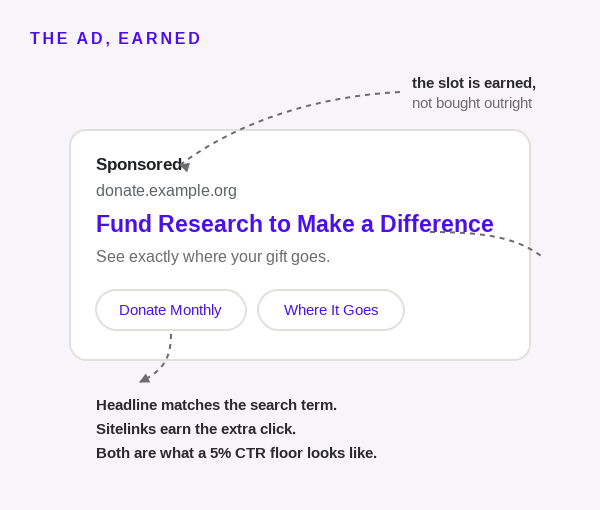
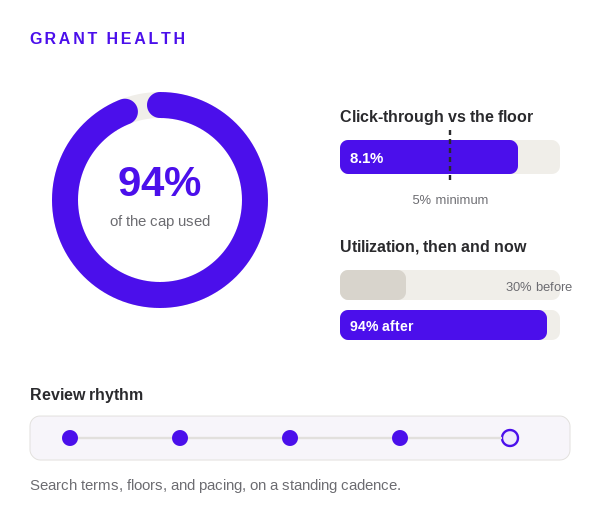
The sequence was deliberate: validate analytics, wire conversion tracking, then consolidate campaigns and clean the keywords before touching a single ad. Conversions imported into Google Ads gave bidding a target. Then the ads themselves were rebuilt, two to three responsive search ad variants per campaign, testing mission language against urgency against benefit-first messaging. Roughly 60 percent of the click-through gain came from keyword pruning and 40 percent from the new ads: 4.1 to 8.1 percent, with utilization reaching 94 percent of the cap over six months.
Like everything in that engagement, it was built to be handed off: governance documentation, a monthly optimization checklist, campaign naming standards, a keyword review process, a dedicated Ad Grants dashboard, and a training session to hand it over. Six months later, utilization was still above 90 percent on the team's own optimization rhythm. A grant account needs the same upkeep every month, so the handoff matters as much as the rebuild. The rest of that engagement has its own page too.
Grant utilization from about 30% to 94% of the monthly cap in six months
Click-through from 4.1% to 8.1%, double the compliance floor, on pruning plus rebuilt ads
Still above 90% utilization six months after handoff, on the team's own rhythm
Building the Rails for Commercial Spend
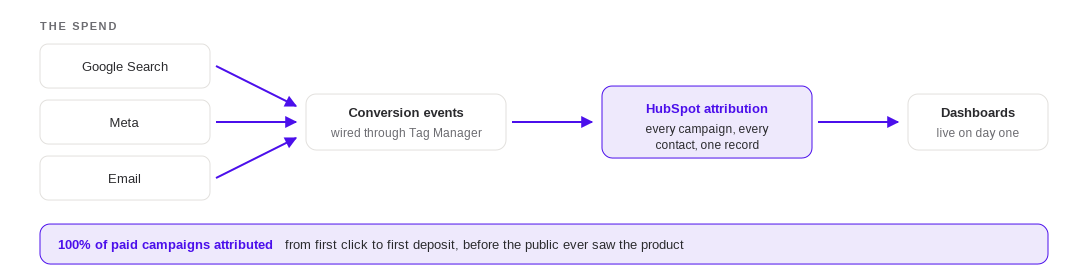
A sports gaming platform was four months from launch, with acquisition planned across Google Search, Meta, and email, and nothing underneath it: no tracking, no attribution, no way to know which dollar did what. With a grant you can learn slowly. This spend was going to start on day one.
My job was the architecture underneath the spend. Conversion tracking wired through Tag Manager, campaign attribution flowing into HubSpot so every paid click attached to a contact record, dashboards that read from the source, and the lifecycle automation that caught what acquisition brought in, from signup through verification to first deposit. The full measurement chain was documented and taught, so the team could judge every campaign against a defined acquisition cost from its first impression.
At launch, 100 percent of paid campaigns flowed through attribution, and onboarding, activation, and promotional journeys were live to receive them. The success here was readiness: a commercial acquisition program that opened its doors already knowing how to count.
Google and Meta launch campaigns running on measurement built here
100% of paid campaigns wired into HubSpot attribution before the public launch
Acquisition dashboards live on day one, from first click to first deposit
In monthly Ad Grant caps, run like bought media.
Two grants at two organizations, each held to the standard a paid account answers to: seen conversions, pruned terms, and floors cleared with room.
Scope of
Involvement
Strategy through operations: keyword architecture, ad copy, conversion bidding, compliance, measurement, and the review rhythm that keeps a grant alive after handoff.
What Scrutinized Dollars Taught Me
The Ad Grant is the best test of paid discipline I know, because it removes the excuse. The money is free, so only the practice decides whether it converts. Both rebuilds came down to the same four chores: see the conversions, bid toward them, prune what the search terms drag in, and hold the floors with margin.
Compliance turned out to be a feature. The program's floors exist to force nonprofits to run real accounts, and treating them as a design constraint rather than a hoop is what kept both grants safe while they scaled.
And paid never works alone. The grants filled the top of the funnel while retargeting worked the bottom, and both only mattered because the measurement underneath them was trusted and the follow-up was ready. What happens after the click is on the email and CRM page.
Email & CRM
Turning Databases Into Relationships
The other half of the funnel: three CRM builds that decided what happened after the click.
Read the case study →
St. Baldrick's
Turning Search Traffic Into Childhood Cancer Research Funding
Web, SEO, and HubSpot for a national childhood cancer nonprofit, through to the shirts people actually wear.
Read the case study →